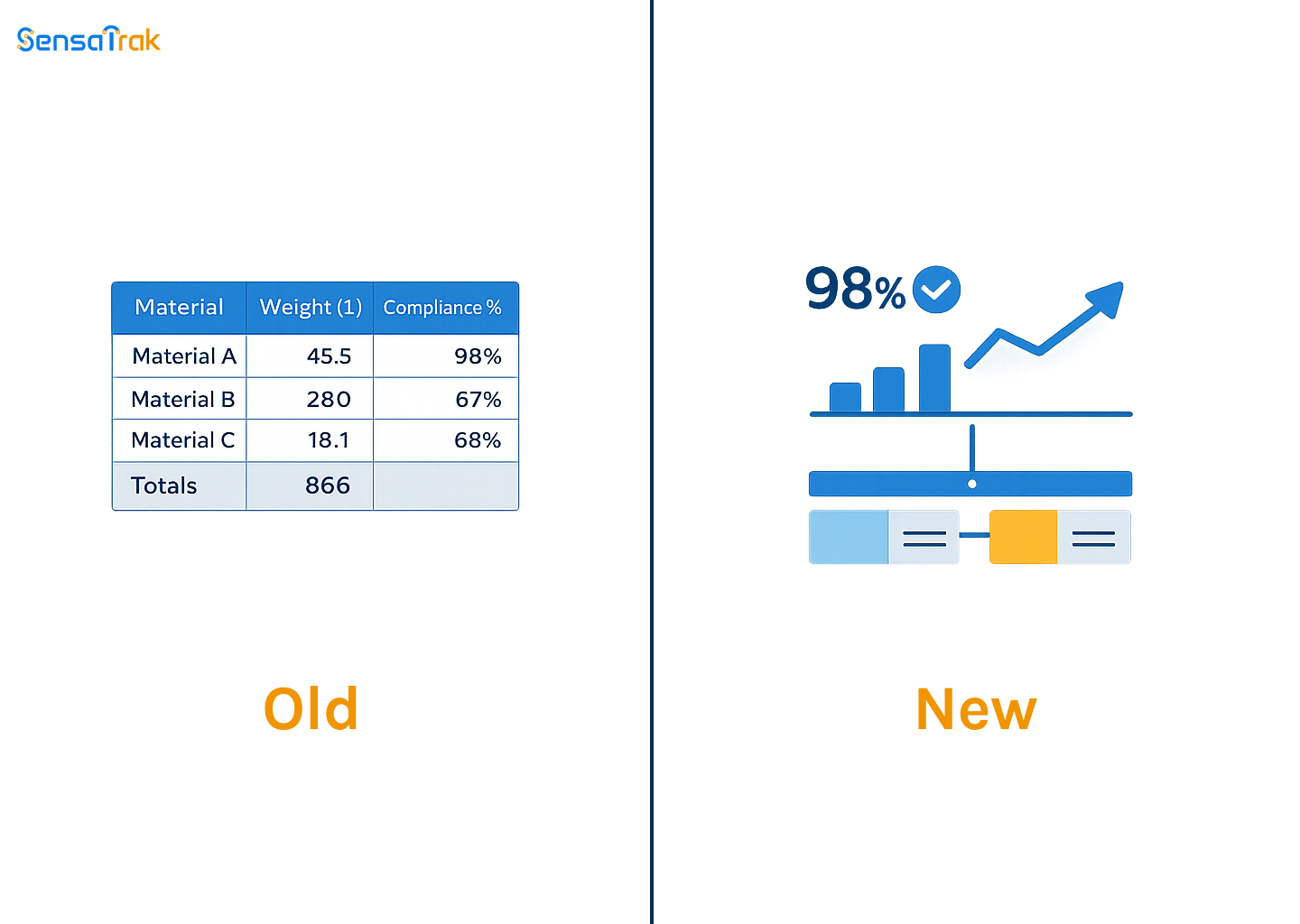
Returnable asset tracking solutions help logistics teams answer these questions very well.
Where are the assets?
Which locations are losing them?
How many plastic pallets are missing?
Which sites need more units?
Are roll cages coming back on time?
Those questions still matter. But under the EU PPWR, the tracking applications and the logistics operations team would need to go a step further.
What does EU PPWR change briefly?
The regulation entered into force on 11 February 2025 and applies from 12 August 2026.
From there, the direction becomes much clearer for reusable and transport packaging: stronger labelling, digital data carriers, trip and rotation logic, reuse-system participation, and reuse targets from 2030 for transport packaging formats such as pallets, foldable plastic boxes, boxes, trays, plastic crates, intermediate bulk containers, pails, drums, canisters, and pallet wrappings or straps.
That changes the role of returnable asset tracking.
Tracking is no longer only about recovering assets, reducing losses, or improving movement across the network.
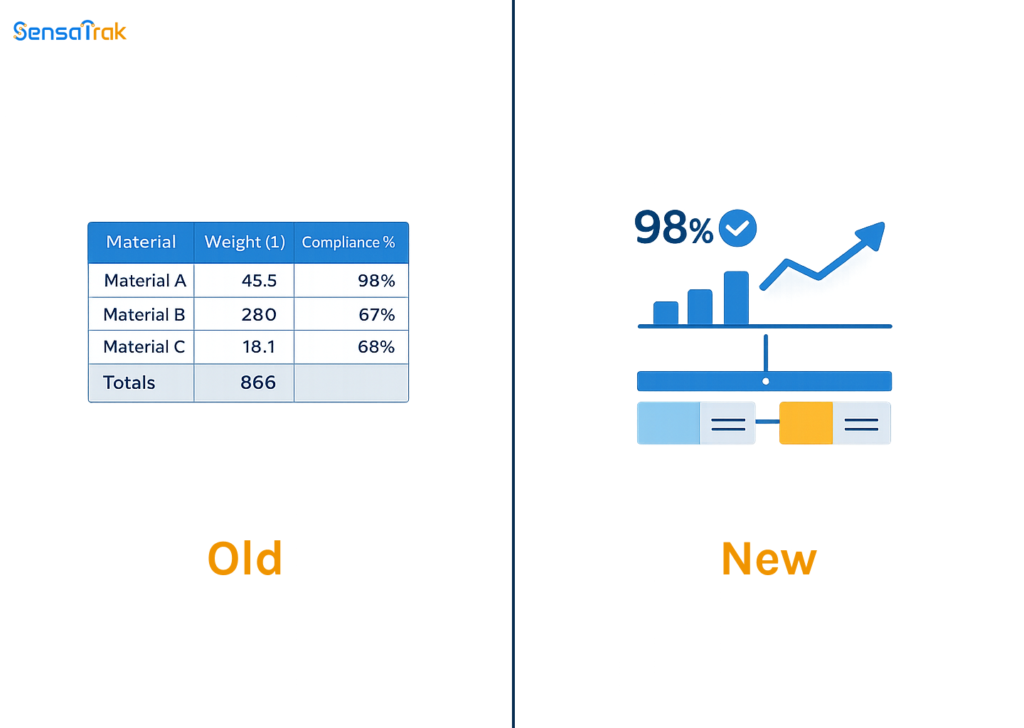
It is starting to support proof. Logistics providers now need to think about whether their systems can identify reusable assets clearly, show how those assets move through reuse loops, and support reporting that holds up when sustainability and compliance questions get sharper.
This is why this blog is best read as a guidance document to prepare well for the ongoing changes.
I don’t want to make this a legal summary. Neither a deep sustainability regulations breakdown.
This is a practical checklist for logistics providers who need to understand what changes PPWR brings for returnable asset tracking and reporting, and what they should start monitoring now.
What does EU PPWR ask you about returnable assets?
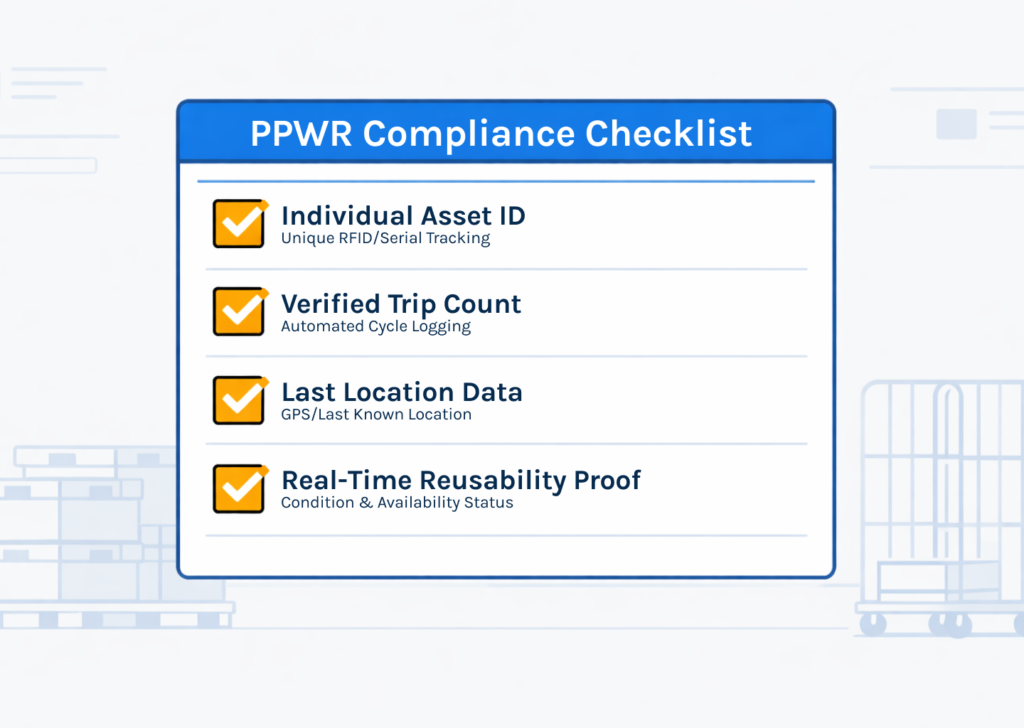
1. Can you clearly identify each reusable asset across the network?
Under EU PPWR, reusable packaging is moving toward clearer identification.
The Regulation says further information on reusability, collection points, and reuse-system availability must be made available through a QR code or other standardised, open digital data carrier, and that data carrier should facilitate tracking and the calculation of trips and rotations.
That means each asset’s identity becomes an integral part of your overall compliance posture under EU PPWR.
For logistics providers, this raises a basic question.
Can each reusable packaging unit be clearly recognized in the flow of operations, or is the network still relying on broad counts, batch-level assumptions, or inconsistent partner-side records?
If the asset cannot be reliably identified as a single data point, it becomes harder to support the rest of the compliance story later.
2. Can you track trips, rotations, and reuse activity beyond location?
This is one of the clearest shifts in the PPWR text. The digital data carrier is tied not only to tracking, but specifically to the calculation of trips and rotations, or an average estimation where exact calculation is not feasible.
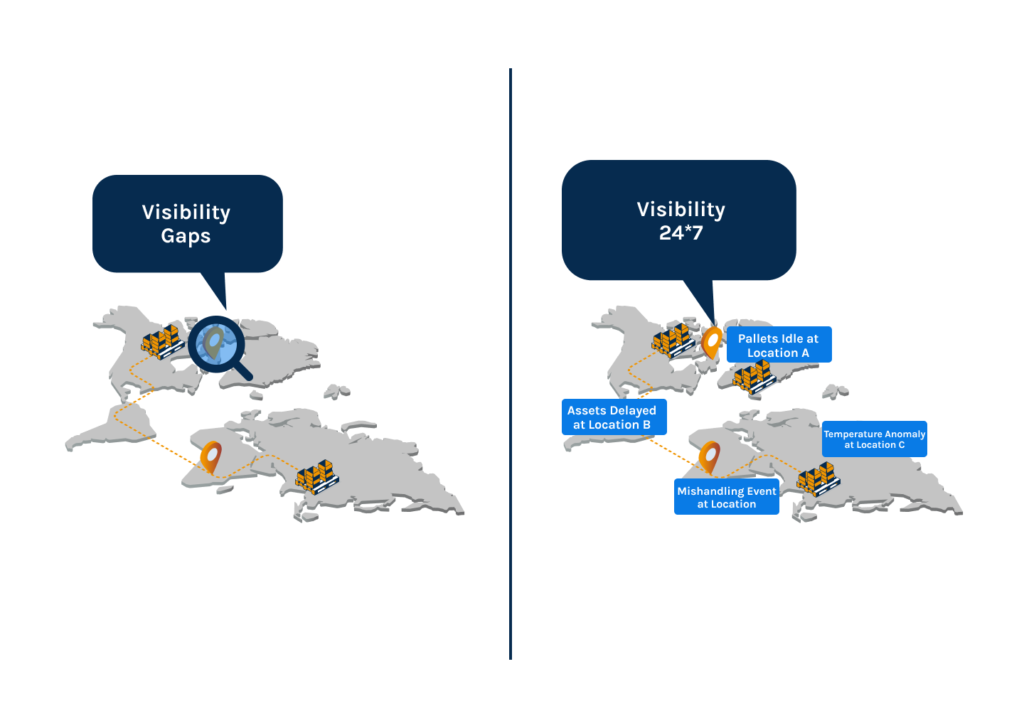
That is a very different standard from traditional tracking setups that mainly answer where an asset is right now.
For plastic pallets and similar transport packaging, this matters immediately. A system that only provides intermittent location updates may help with visibility, but it does not automatically help prove reuse performance.
The stronger question now is whether the business can show if the assets are really circulating through the loop over time.
That is where returnable asset tracking starts overlapping with reporting. This shifts the focus of asset tracking solutions from just operational efficiency to sustainability & compliance optimization as well.
3. Can you show that those assets follow a proper reuse system?
EU PPWR does not stop at just encouraging the use of reusable packaging.
It says economic operators making use of reusable packaging must participate in one or more re-use systems, and that those systems must comply with Annex VI requirements.
Annex VI of the EU PPWR defines what a proper re-use system should look like. It covers how reusable packaging should be collected, returned, handled, reported on, and reconditioned before it goes back into use. So the requirement is not just to reuse packaging, but to manage it through a structured system with clear operational and data controls.
The framework also says packaging used in those systems must be reconditioned before being offered again for use by end users.
That puts increasingly more accountability with the logistics network operators.
From a logistics point of view, the business needs to know whether assets are staying inside a governed loop, whether they are being recovered properly, and whether they are being returned into circulation through a controlled process.
Without that, asset movement may still be visible, but the reuse model behind it stays weak.
4. Can you record condition, reconditioning, and lifecycle status?
This is where many of the conventional tracking setups start looking incomplete.
PPWR’s logic is not only about whether packaging comes back. It is also about whether it remains fit for reuse and can be reconditioned while maintaining its intended function.
The Regulation explicitly says reusable packaging must be capable of being reconditioned, and economic operators using reusable packaging must ensure that reconditioning happens in line with the framework
So the practical question becomes: do you only know where the asset is, or do you also know whether it remained usable, whether it was damaged, whether it was cleaned, repaired, or reconditioned, and when it should be removed from the loop?
5. Can your reporting justify your sustainability claims?
From 1 January 2030, economic operators using transport packaging in formats such as pallets, foldable-plastic boxes, boxes, trays, plastic crates, intermediate bulk containers, pails, drums and canisters must ensure that at least 40% of that packaging in total is reusable packaging within a re-use system.
The Regulation also sets stronger rules for packaging used between sites of the same operator, linked enterprises, partner enterprises, or deliveries to another economic operator within the same Member State, where that packaging must be reusable within a re-use system from the same date.
That implies that your tracking reporting will need to rest on something more than just intent and data.
Logistics providers will need records that support how reusable packaging is identified, how it circulates, where it exits the loop, and whether the packaging in scope is in fact functioning with a good reuse system.
Are your current tracking tools strong enough for this shift?
A lot of legacy setups were built for one of three jobs: asset recovery, location visibility, or stock control.
Those jobs still matter. But PPWR raises the bar. A tracking setup that only shows location snapshots, relies heavily on manual reconciliation, or keeps condition and movement data in separate systems may struggle to support what the regulation is now pushing toward: stronger identification, trip and rotation logic, reuse-system participation, reconditioning records, and reporting that can stand behind compliance conversations.
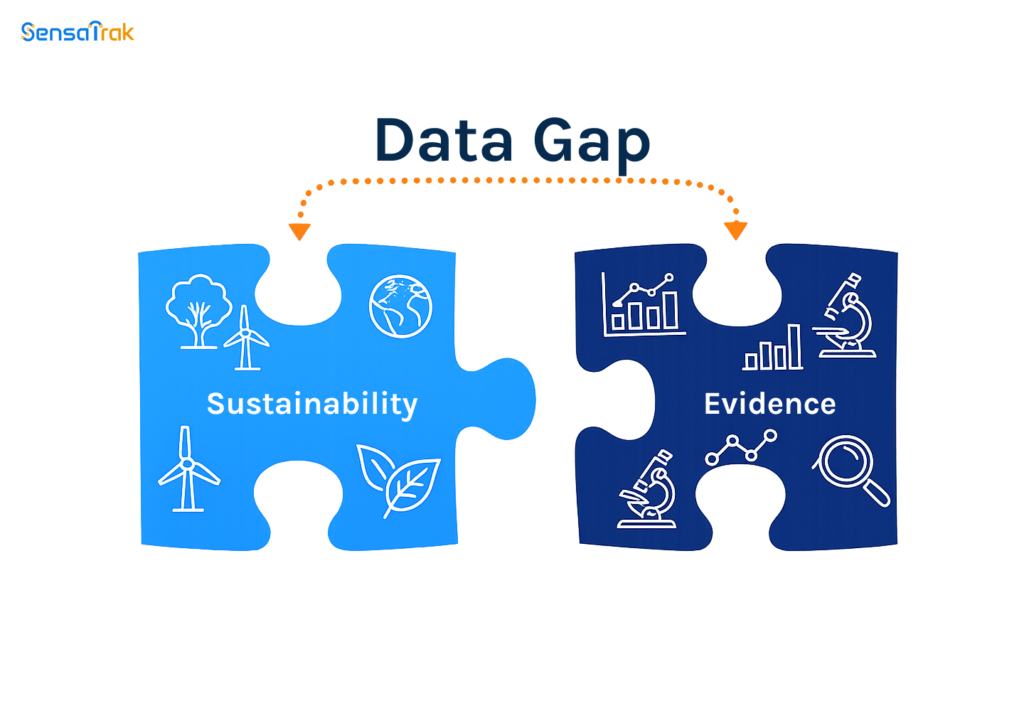
This is where the real gap shows up.
Nowadays, a lot of the logistics teams have returnable asset tracking. But very few teams have returnable asset tracking that is structured enough for reporting and compliance use.
How does SensaTrak support this shift?
SensaTrak fits this shift because it is not built as a narrow location-tracking tool.
On the live site, SensaTrak is positioned around trackers, platform, integrations, monitoring, and historical records, with a subscription model that combines hardware, software, maintenance, and support.
The platform also highlights utilization, movement, condition monitoring, audit-oriented history, and integration with ERP and WMS environments.
From a practical point of view, that matters in five ways:
- Creating a stronger layer for asset identity, because the tracking model starts at the asset level rather than at rough inventory summaries.
- Helping with movement and utilization visibility, which is the base for understanding trips and circulation patterns.
- Reducing fragmentation through integrations, so the asset story does not stay trapped in one disconnected tool.
- Building a better record for condition and lifecycle monitoring, instead of separating those signals completely from movement data.
And finally, it helps create historical evidence, which becomes more valuable when sustainability and compliance reporting need to point back to actual operational records.
It is not meant to replace compliance work. But it makes the compliance work seamless with ready customizable reporting that fits your requirements.