If you’re running a 3PL operation or managing returnable assets across European borders, your tracking infrastructure has to work in more than one country. That sounds obvious, but in practice, it’s where most asset tracking solutions start losing data.
A plastic pallet that moves from a warehouse in the Netherlands to a distribution hub in Germany and then to a retail facility in Poland might cross two or three national boundaries in a single trip.
The pallet doesn’t care about borders. But the tracker on it does.
Cross-border tracking for returnable assets in Europe runs into problems that have very little to do with the tracking hardware itself.
The issues are in the connectivity layer underneath: cellular network handoffs, permanent roaming restrictions, inconsistent LTE-M and NB-IoT coverage, and the regulatory grey areas around IoT devices that sit on foreign networks for months at a time.
For 3PL networks in Europe, these aren’t edge cases. Cross-border movement is the default operating mode.
And when your asset tracking solution can’t maintain a reliable data stream across borders, the downstream effects show up in everything from fleet counts to recovery scheduling to compliance reporting.
This blog looks at why cross-border tracking for returnable assets is structurally harder in Europe than most teams expect, where the connectivity and data gaps actually come from, and what an asset tracking solution needs to handle to work reliably across multi-country operations.
Why does cross-border tracking break down in European logistics?
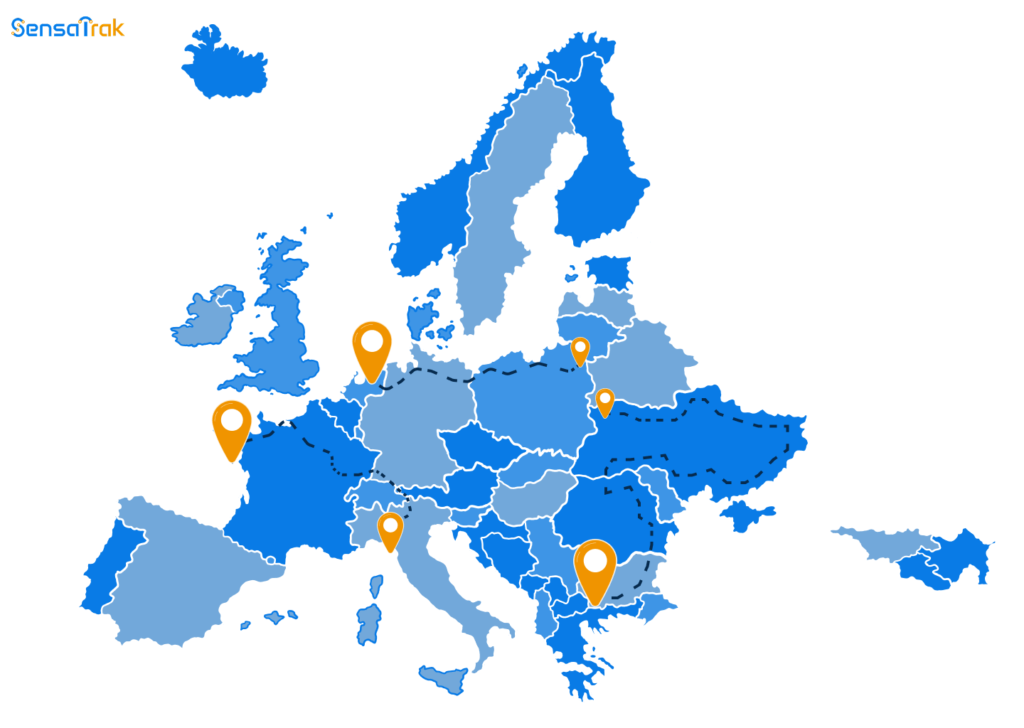
European logistics is cross-border by default. A plastic pallet moving from a warehouse in the Netherlands to a distribution hub in Germany and then to a retail facility in Poland might cross two or three national boundaries in a single trip.
For 3PL networks in Europe, this kind of multi-country movement is a routine affair.
Most asset tracking solutions rely on cellular connectivity to transmit location and sensor data back to a platform.
That connectivity works through SIM-based authentication with a home carrier network. When the tracker stays within the home carrier’s coverage, everything works as expected.
The problems start when the device crosses into another country and connects to a foreign network.
What is permanent roaming and why does it affect asset tracking?
When an IoT tracker enters a foreign country, it connects to a local network through a roaming agreement between carriers. For a consumer phone, this is temporary. The traveler comes home in a few days, and the roaming session ends.
A returnable asset tracker doesn’t work that way. A roll cage might sit in a Polish depot for three or four months before cycling back to its home country.
During that time, the tracker is permanently roaming on a foreign network. Many mobile network operators either throttle data speeds or disconnect devices that stay on a visited network beyond a set window, often between 30 and 90 days.
Kaleido Intelligence survey found that roaming restrictions rank among the top three factors affecting cellular IoT deployment worldwide.
Within the EU, permanent IoT roaming isn’t explicitly banned, but it sits in a regulatory grey area. BEREC’s March 2025 opinion specifically called for clearer frameworks around IoT and M2M permanent roaming, which tells you the current rules don’t cover it well enough for logistics operators to rely on.
The EU’s “Roam Like at Home” regulation was designed for people traveling with phones. It was not designed for IoT devices that live on foreign networks for months at a time.
Network technology varies significantly across European markets
Europe isn’t a unified network. It’s 27+ national networks, each with different levels of LTE-M and NB-IoT rollout. A tracker that relies on NB-IoT might perform well in the Netherlands or Germany but find limited or no NB-IoT coverage in parts of Southern or Eastern Europe.
When that happens, the device falls back to LTE-M, or in some cases to 2G/3G networks that are actively being phased out in several countries.
Each fallback changes the power consumption profile, the reporting frequency, and the reliability of the data being transmitted.
A Digital Matter field test on cross-border IoT roaming showed that the first handoff from LTE-M to NB-IoT could take up to 120 seconds for network registration. That’s two minutes of silence from a tracker that your platform assumes is reporting continuously.
For a single asset, a two-minute gap is negligible.
For a fleet of 20,000 reusable pallets and roll cages crossing borders daily across a European 3PL network, those gaps add up into data inconsistencies that affect fleet counts, dwell time calculations, and recovery scheduling.
Home-routed data adds latency that compounds at scale
When an IoT device roams, its data typically routes back through the home carrier’s core infrastructure before reaching the tracking platform. This adds 150 to 300 milliseconds of latency per transmission. For one GPS ping from one tracker, that delay is unnoticeable.
But for an asset tracking solution processing thousands of data points from trackers scattered across five or six countries, the cumulative latency creates a significant gap between the data on your dashboard and the real movement.
Location data arrives slightly stale. Alerts trigger slightly late. And your operations team makes decisions on information that’s always a few steps behind reality.
Connectivity costs become unpredictable across borders
IoT roaming data costs vary depending on the wholesale arrangements between carriers in each country.
A tracker transmitting the same data volume in France and Romania might generate very different connectivity costs depending on which carrier agreements are in place.
For 3PL networks tracking tens of thousands of returnable assets across multiple European markets, this makes connectivity budgeting unreliable and hard to forecast accurately.
When you add up permanent roaming risks, inconsistent network coverage, data latency from home routing, and unpredictable costs, you get a connectivity layer that was never designed for the way returnable assets move through European logistics networks.
What does this mean for 3PL networks managing returnable assets across Europe?
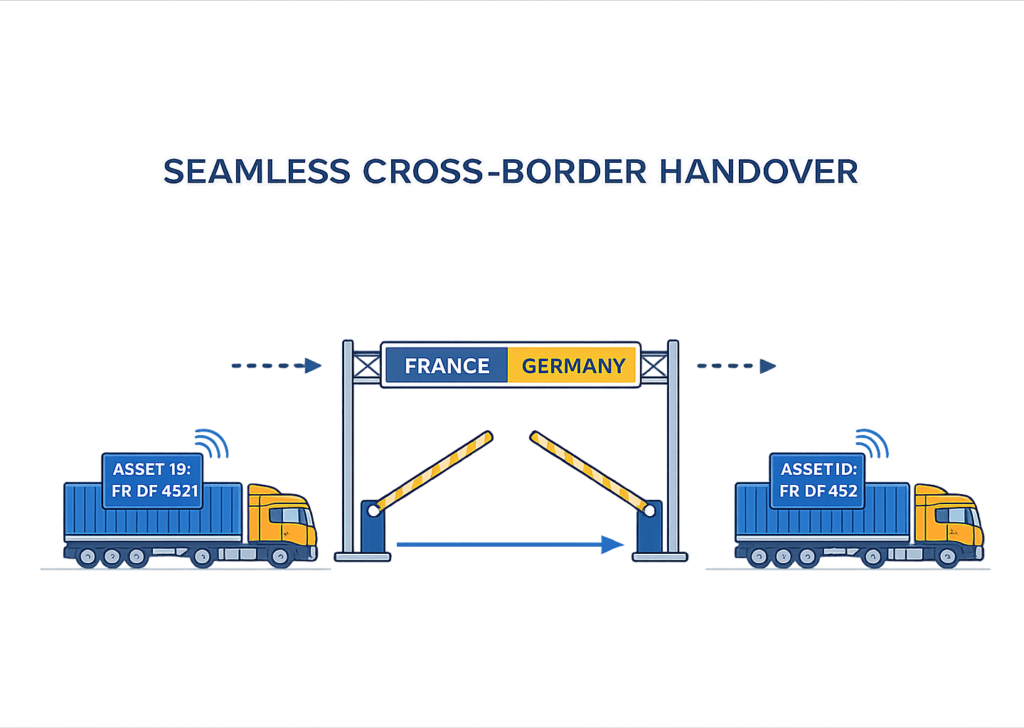
These connectivity problems eventually show up as operational issues that your teams have to deal with every day, often without realizing the root cause is a tracker that lost signal at a border crossing or sat on a throttled network for six weeks.
How do connectivity gaps affect fleet visibility across countries?
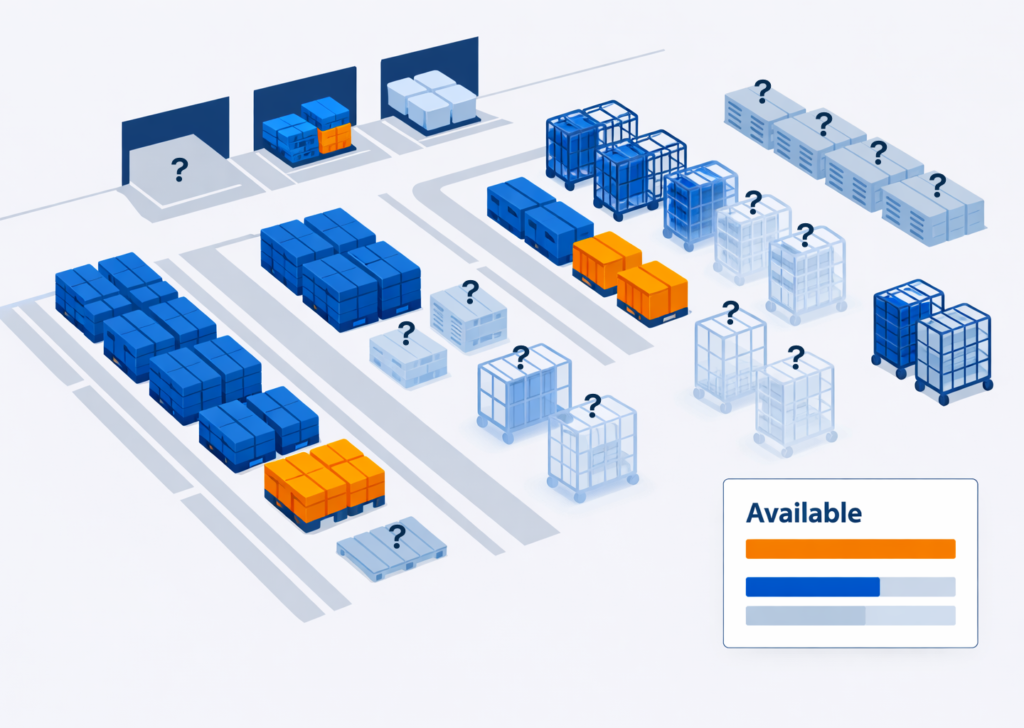
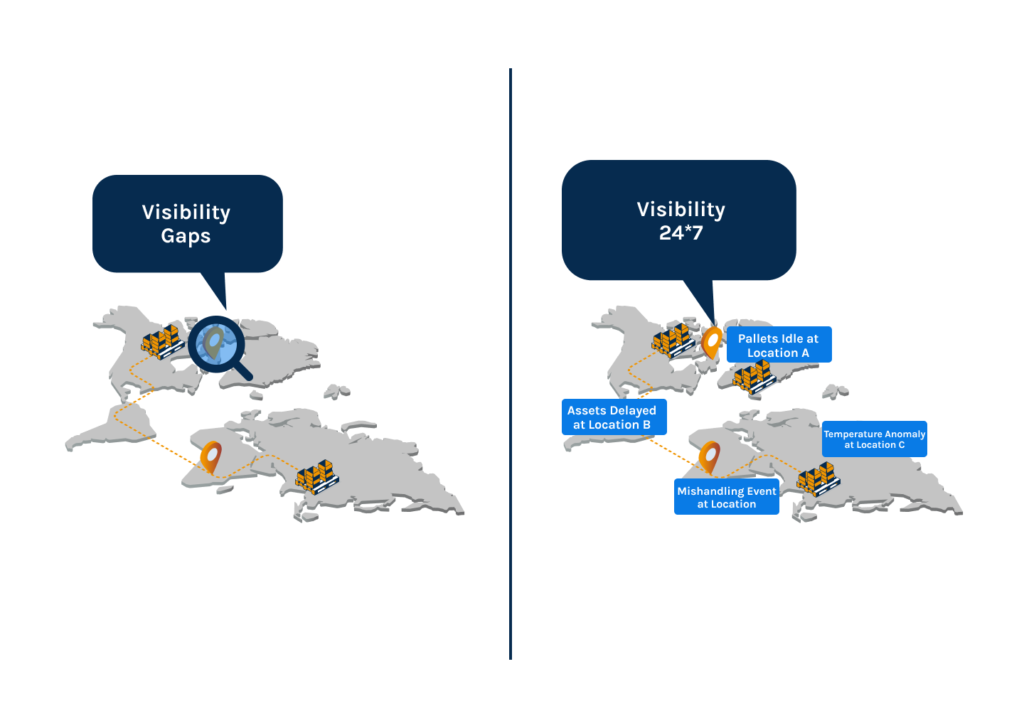
When trackers drop data during border crossings or network handoffs, your platform receives an incomplete picture of where assets are.
A roll cage that crossed from Belgium into France might show its last known location as a Belgian depot, even though it arrived at a French distribution center hours ago.
Your operations team in France doesn’t see it in their system. But your team in Belgium still counts it as local inventory.
Multiply that across thousands of assets moving between countries daily, and your fleet counts start diverging from reality in ways that are difficult to trace back to a specific cause.
The numbers in your dashboard say one thing, your warehouse teams say another, and nobody can pinpoint exactly where the discrepancy started.
What happens to recovery scheduling when data arrives late or inconsistent?
Recovery scheduling for returnable assets depends on knowing where assets are dwelling and for how long. If a tracker’s data is delayed by home-routed latency, or if it goes silent during a network fallback, your dwell time calculations for assets in foreign countries become unreliable.
An asset that has been sitting idle at a client site in Italy for three weeks might only show two weeks of dwell time in your system because the tracker lost a week of reporting during a roaming handoff.
Your recovery team schedules pickups based on what the system shows. The system shows incomplete data. Assets stay out longer than they should, idle stock accumulates in the wrong countries, and your capital sits tied up in locations you can’t see clearly.
How does this affect compliance reporting across multiple EU markets?
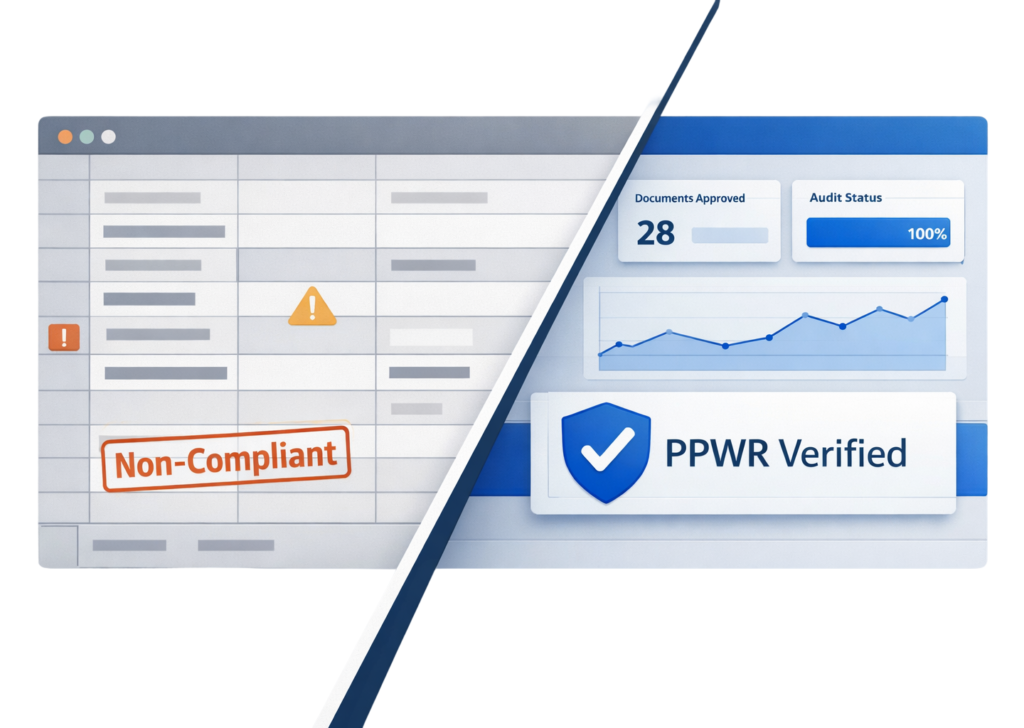
For 3PL operators managing returnable assets across European markets, compliance reporting increasingly requires granular, asset-level data on reuse cycles, condition history, and lifecycle performance.
Regulations like PPWR expect you to demonstrate that your reusable packaging is actually being reused at the rates you claim.
When your tracking data has gaps at every border crossing, building a continuous audit trail for an asset that has moved through four countries in a single quarter becomes a manual reconciliation exercise.
Your compliance team ends up filling holes in the data rather than generating reports from it.
In a regulatory environment that’s moving toward requiring verifiable, digital records of asset reuse, patchy cross-border data becomes a big liability.
Why is this particularly difficult for returnable assets?
Returnable assets cycle through the same routes repeatedly. A plastic pallet might move through Germany, Austria, and the Czech Republic in a single loop, and repeat that loop dozens of times a year.
Every border crossing is a point where the tracker might lose signal, switch networks, experience latency, or get throttled. And because the asset keeps cycling, those small data disruptions compound across every loop.
Over six months of operations, a 3PL managing a large fleet of reusable pallets and roll cages across European borders accumulates enough cross-border data gaps that their reported utilization, dwell times, and fleet availability become increasingly approximate.
The teams using that data to make capital and scheduling decisions don’t always know how approximate the numbers really are.
How SensaTrak’s connectivity architecture handles multi-country operations?
Most asset tracking tools were built assuming the tracker would operate within a single country or a single carrier’s coverage area. Therefore, the connectivity issues are commonly felt when traversing across broders.
SensaTrak is built for multi-country European operations from the start.
The connectivity architecture uses eSIM with multi-carrier arrangements across European markets, which means the tracker can switch to a local carrier profile when it enters a new country.
The device registers as a local device on a local network. It avoids permanent roaming restrictions entirely, because it’s never permanently roaming. It’s always local.
This removes the 30-90 day disconnection risk, eliminates the latency penalty from home-routed data, and gives your fleet consistent reporting behavior whether the asset is in the Netherlands, Poland, or Spain.
What about the network inconsistency problem?
SensaTrak’s trackers operate on LTE with LP-GPS positioning, which means they don’t depend on NB-IoT or LTE-M availability in each market.
LTE coverage across Europe is far more consistent than LPWAN rollout, so the device maintains a reliable data connection even in regions where newer IoT-specific network standards haven’t been fully deployed yet.
LP-GPS handles outdoor positioning at lower power draw, and the LTE backhaul keeps sensor and location data flowing without falling back to legacy 2G/3G networks that are being decommissioned across the continent.
Connectivity is only half the problem
Keeping trackers connected across borders keeps the data flowing. But data arriving from five or six different network environments, each with slightly different latency profiles, reporting intervals during handoffs, and signal conditions, still needs to be processed before your team can trust it.
This is where Acceleronix & Observability, the data and analytics engine behind SensaTrak, becomes relevant.
They ingest tracking data from every network environment, normalize it against the asset’s known journey, reconcile timing inconsistencies from cross-border handoffs, and deliver a clean, unified data stream into your dashboard, ERP, or WMS.
Your operations team sees one consistent view of every asset, regardless of which country or carrier network the data came from.
Seamless connectivity makes sure data keeps arriving.
And the data engine makes sure what arrives is accurate and usable.
Together, we give 3PL networks managing returnable assets across European borders something that many asset tracking solutions can’t deliver: reliable, continuous visibility that doesn’t degrade every time an asset crosses a national boundary.